 |
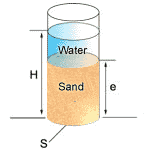
Permeability is the ability of a medium to permit a fluid to flow through it. This property is generally expressed numerically by the Darcy permeability coefficient K. This coefficient has been established by studying the flow of water through a column of sand. |
 |
|
There is no direct correlation between porosity and permeability, but to be permeable the rock should be porous.
For example in hydrology, clays behave like impermeable rocks. They are very porous and have, as they are dry, an appreciable permeability. But when clay is wet, the water films absorbtive on the clay plates make it impermeable.

 Granulometry and permeability.