|
It ensues from previous chapters that electrical resistivity
of a rock depends mainly on quantity of water in a unit volume of rock,
and on the quality of this water.These factors are taken into account
in an extremely important experimental law established for saturated media:
It is the "Archie law" (Archie 1942)
which links the resistivity of the rock, the porosity, the nature of distribution
and the resistivity of the electrolyte.
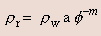 |
 =
Resitivity of the imbibition water =
Resitivity of the imbibition water =
porosity =
porosity- a = factor which depends of the lithology
and that varies between 0.6 and 2 (a < 1 for rocks with intergranular
porosity and a > 1 for rocks with fractured porosity)
- m = cementation factor (It depends of the
pores shape, of the compaction and varies between 1,3 for unconsolidated
sands to 2,2 for cimented limestone.
|
| Generally the parameters are known
as Formation Factor |
|
Pratically the following relationships are generally
accepted:
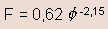
| For unconsolidated formations
(sandstones, sands) : Humble's formula |
|
| For well cemented and consolidated
formations |
|
 |
Download graph 3 |
| Archie's expression for saturated
rock then becomes : |
|
|