After having determined which type of curve corresponds to our sounding we will interpret this sounding to determine the resistivity and the thickness of the three layers. In the case of horizontal, laterally infinite layers, one unfortunately shows that to a given succession of resistivity and thickness corresponds only one diagram of electrical sounding well defined, the reverse is not true. An electrical curve of sounding can correspond to distributions very different of the resistivity and thickness, which can lead to an indetermination. There is plurivocity of interpretation. This indetermination appears in two particular forms, which received the name of principle of equivalence and principle of suppression
Principle of equivalence
The principle of equivalence concerns such a bed for which the resistivity is either greater than, or less than, both for the beds above and below the bed itself. Electrical soundings type K and H.
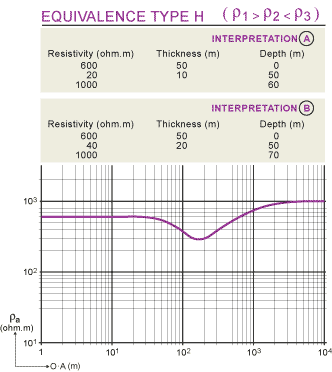
 Example of equivalence for an electrical sounding of type H
A conductive bed between two or more resistant beds,
shows essentially its "longitudinal conductance" thickness divided by
the resistivity (h/ ),
electrical sounding of type H. As long as this ratio stays the same the
curve is unchanged. The limits of validity of this principle depend on
the characteristics of the whole suit of beds present.
),
electrical sounding of type H. As long as this ratio stays the same the
curve is unchanged. The limits of validity of this principle depend on
the characteristics of the whole suit of beds present.
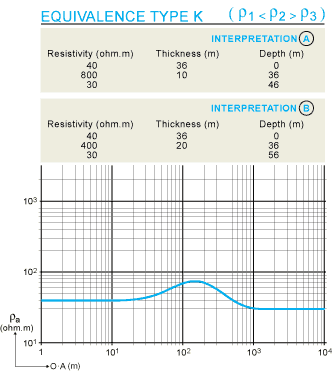
Example of equivalence for an electrical sounding of type K
A resistant bed, between two or more conductive beds,
manifests itself mostly by its " transverse resistance"(h*)
or the product of its resistivity and its thickness, electrical sounding
of type K. As long as this product remains constant and in some limits,
the electrical sounding remains unchanged.