The results of electrical soundings are represented in graphe in which the half length of the configuration AB/2 = OA is plotted on the abcissa and the corresponding apparent resistivity is plotted, on the ordinate. The scale of both axes are logarithmic.
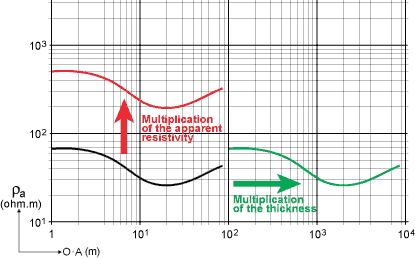
 Diagram bilogarithmic for the representation of the electrical sounding
 |
Download bilogarithmic diagram |
Such a scale is a natural choice for some reasons:
- This scale produced the same graphical variation for a relative variation of the variable as the precision expected in resistivity as in depth, being more logically in relative values.
- The effect of a given structure diminishes with depth, and at the same time there is a loss of precision with which we can determine its dimensions. For near surface problem a precision inferior to 1 m could be requiered, while when we want the determination of the depth of the bedrock at hundred meters, the precision could be 10 meters.
- The same reasoning is true in the case of the resistivity. We can hope to determine the resistivity of a conductive clay to within one ohm-meter, whereas such precision would be completely out of question for a resistant limestone.
A second advantage of the logarithmic scale is:
- If we multiply all the electrode separations and bed thicknesses involved by the same factor the curve obtained is the same and simply translated parallel to the abcissa.
- If all of the resistivities in a given geological section are multiplied by the same factor, the result is a simple translation of the original curve parallel to the ordinate.
- To facilitate comparison of the field curves with theoretical curves.