Let us examine now how to measure the resistivity
of the rocks. The Ohm 's law enables us to envisage the flow of current
in a homogeneous and isotropic medium. Considering an homogeneous and
isotropic formation of resistivity  limited by a plane surface on the side of the air, we send a D.C. current
using a specific electrode A.The current flows radially outward in all
direction from the point A and will produce variations of potential in
the ground because of the ohmic resistance of this one. The distribution
of the potential can be represented by half-spherical surfaces centered
on A.
limited by a plane surface on the side of the air, we send a D.C. current
using a specific electrode A.The current flows radially outward in all
direction from the point A and will produce variations of potential in
the ground because of the ohmic resistance of this one. The distribution
of the potential can be represented by half-spherical surfaces centered
on A.
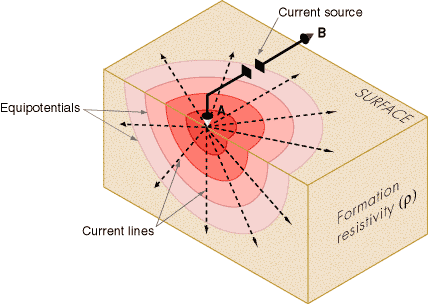
 Equipotentials and current lines for a simple source.
In an isotropic homogeneous medium the potential V
due to a point source decreases proportionally to the distance R, and,
in addition proportional to intensity I of the current sent and the resistivity
of the medium. If
we compare the formation to a half space homogeneous and infinite, the
proportionality factor will be equal to 1/2  ;
and by applying the Ohm's law to space separating two equipotentials between
which exists a tension V we obtain:
;
and by applying the Ohm's law to space separating two equipotentials between
which exists a tension V we obtain:
 by integration
  |
with : |
with 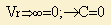
or if we take into acount the electrical field:
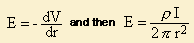 |
E = electrical field [V/m] |