The "Mise-à-la-masse" method is a variation of the equipotentials map. In this case a conductor body acts as an electrode in which the current is injected. The whole of the body then plays more or less the role of an electrode, all its surface putting itself appreciably at the same potential. This method is used especially in mining prospecting.
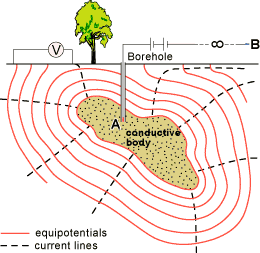
 Principle of "Mise-à-la-masse" method
To use this method it is necessary:
- That the resistivity of the conductive bodies is very low
- That the conductor is continuous
- That the conductive zone is already located and exposed either as outcrop or in a drill hole
The conductive bodies that can be mapped using this technique are generally mineralised zone of copper sulphide, nickel and lead.
The current tends to run out uniformly from the conductive bodies in the surrounding rocks. Under ideal conditions there should be a potential uniformly distributed on the surface of the conductive body. Actually the shape of the body, its dip and its contrast of resistivity with the surrounding rocks modify this distribution. The more the contrast is the more the distribution of the potential is done uniformly on the surface of the mineral body. When contrast decreases, the potential cartography of the shape of the body is less precise and, if there is no contrast, a hemispherical distribution of potential is found.
When two mineralized bodies are close, there can be an effect of " leakage ". The current passes from the body where is the power source in the adjacent body. The voltages measured above the adjacent body are lower.
The dip can also be given. The strong voltages are close to the higher part and the equipotentials deviate towards the dip.