For a null porosity, the neutron (limestone calibrated
) will read 0 opposite limestone and the density corresponding to that
of the calcareous matrix will be  b
= 2,71 g/cc.
b
= 2,71 g/cc.
For a porosity  of 20 % with always f
= 1 and a neutron (limestone calibrated) , the porosity read by the neutron
is 20 % and the density read is then b=
2,36 g/cc.
of 20 % with always f
= 1 and a neutron (limestone calibrated) , the porosity read by the neutron
is 20 % and the density read is then b=
2,36 g/cc.
We use these Charts in the following way:
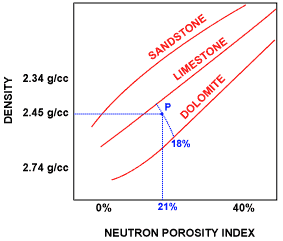
 Schematic explication of the method
The reading of the density and the Neutron will give us a dot on the Chart.
| neutron
= 21 |
b
= 2,45 g/cc |
These values determine a point P which is between the curve of limestone and dolomites and which practically falls on the line corresponding to 18 % of porosity. The measurement of the distance from the point P to the curves matrices (in red) limestone and dolomite makes it possible to evaluate the relative percentage of the components of the matrix. If it is admitted that the matrix is made up only of limestone and dolomite, that gives us 40 % of dolomite and 60 % of limestone. An error in the choice of the components of the matrix does not introduce a large error into the estimate of porosity, in so far as the components of the matrix are restricted with quartz, calcite, dolomite, other than clay and gypsum.
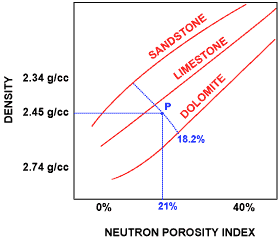
In the example above, if for example instead of limestone-dolomite, the matrix is a double component quartz - dolomite, porosity will become 18,3% instead of 18% and the proportions will be about 45% of quartz and 55% of dolomite.