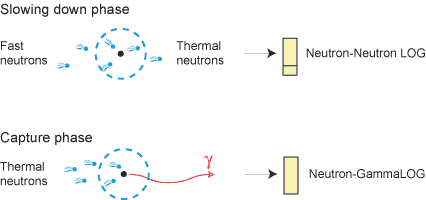
A source emits fast neutrons (initial velocity> 10000 Km/s) and whose initial energy lies between 4 and 6 MeV. These neutrons have a high capacity of penetration which enables them to enter in collision with the atomic nuclei of the formation. Progressively with their penetration, they gradually lose their energy according to two phases:
 Corpuscular interaction
- Phase of slowing down: the neutrons are more or less slowed down according to their angles of incidence and according to whether their mass approaches or not that of the nuclei met. The collisions with the hydrogen nuclei have a dominating effect since the mass of this nucleus is appreciably the same one as that of the neutrons. Thus slowed down, the neutrons reach the thermal state in which their energy is worth 0,025 MeV and their speed 2500 m/s. If the detector counts the neutrons thus slowed down we speak then about log Neutron-Neutron.
- Phase of capture: When energy becomes lower than 0,025 Mev the thermal neutrons are finally captured by the nuclei of certain elements. The chlorine nucleus is most effective to capture the thermal neutrons. This capture is accompanied by emission of gamma rays. We speak then about log Neutron-Gamma.