The lateral produces a non-symmetrical curve as opposite resistive or conductive beds. The bottoms of the beds are well indicated. Let us examine the responses of the lateral probe for four typical cases, (with e=thickness of the bed and AO=spacing), to correct the lateral measurement for true resistivity:
1. Thick resistive bed :
- A small negative anomaly appears at the top of the bed.
- Over a distance equal to AO the resistivity remains fairly constant and low. This is the decay zone
- Resistivity then increases and for a thick layer, we observe the appearance of a plateau, the value of which approaches that of Rt
- The bottom of the bed is indicated by a sudden rise in the curve forming a peak, the value of which is much higher than the resistivity of the formation.
- The resistivity then decreases over a distance equal to AO to reach the resistivity of the adjacent layer.
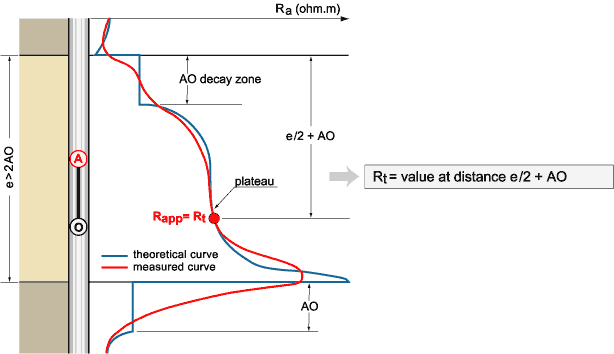
 Response of the lateral in case of a thick resistive bed.
2. Thick conductive bed
- At the top of the conductive bed we observe a resistive peak.
- In the middle portion the resistivity approaches that of Rt
- The resistivity remains low over a lenght = AO below the bed. This is the trailer. This phenomenon is observed even when the conductive layer becomes thin.
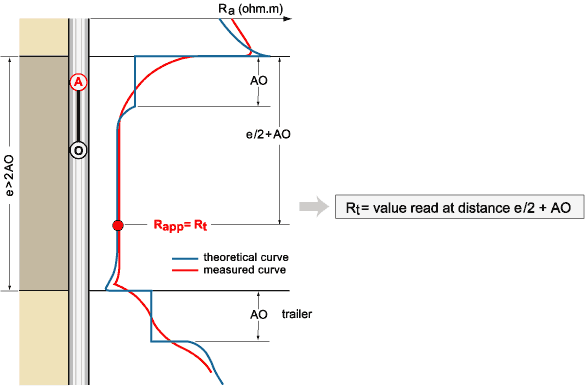
Response of the lateral in case of a thick conductive bed
3. Resistive bed of average thickness
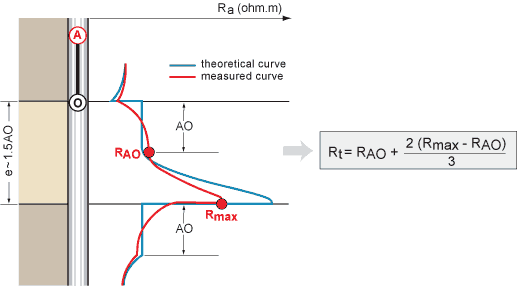
Response of the lateral in case of a resistive bed of average thickness
4. Thin resistive bed
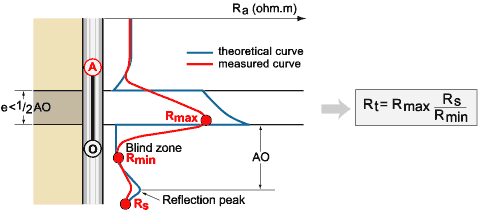
Response of the lateral in case of thin resistive bed