|
The shape and amplitude of S.P. deflections may be
influenced by several factors. These are:
1.Influence of salinity of fluids in contact
The S.P. essentially depends on the difference in
salinity of the fluids in contact, the mud filtrate and the formation
water. Various situations may arise:
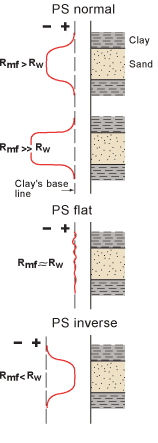
- The formation water is more saline than
the mud filtrate Rmf > Rw. Such S.P. is
considered normal.This is the case we have considered so far.
The positive here is opposite the clays and the deflection toward
the negative signifies the presence of a porous and permeable
formation. The deflection increases with an increase in contrast
of salinities
- The resistivity of the filtrate is close to that of the formation
water Rmf = Rw. The S.P. is termed FLAT. The log shows no clear
difference between the clays and the porous and permeable beds.
- The formation water is less saline than the
mud filtrate Rmf < Rw. In this case, we
obtain an INVERTED S.P..The curve reveals a positive opposite
the permeable layers and a negative opposite the clays. This phenomenon
is often observed in groundwater boreholes.
|
|
|
2.Influence of resistivity
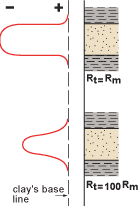
- If the permeable bed has a high resistivity,
S.P. currents do not develop readily. The S.P. deflection and
bed boundaries are less clearly indicated. Charts can be used
to correct this effect
|
|
|
3.Influence of clay
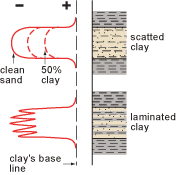
- The presence of clay in the reservoir formation
reduces the amplitude of S.P. deflection. The attenuation is a
linear fonction of the percentage of clay dispersed in the rock.This
property also enables us to calculate the percentage of clay in
permeable formation.
|
|
4.Influence of thickness of permeable bed Generally
The boudaries between the clay and the permeable formation
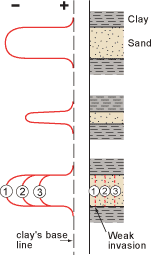
correspond to the points of inflection of the S.P curve. An increase of
borehole diameter reduces the S.P. deflection.
- If the layer is thick, the deflection is maximum and appears
as a plateau
- If the layer is thin, the curve is recorded
as a narrow peak and the static potential is not reached. In this
case to find the maximum theoretical value of S.P. deflection,
correction charts must be used. To use these charts we must know
the thickness of the permeable layer, which can be obtained from
other log.
- As the invasion increases, the S.P. deflection is reduced.
|
|
|
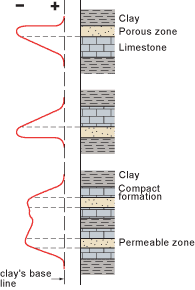
5.Effect of compact formations
- Clay beds interbedded between the compact
layers, for example, limestone, are observed by a change in the
slope of the S.P. curve.
|
|
|